
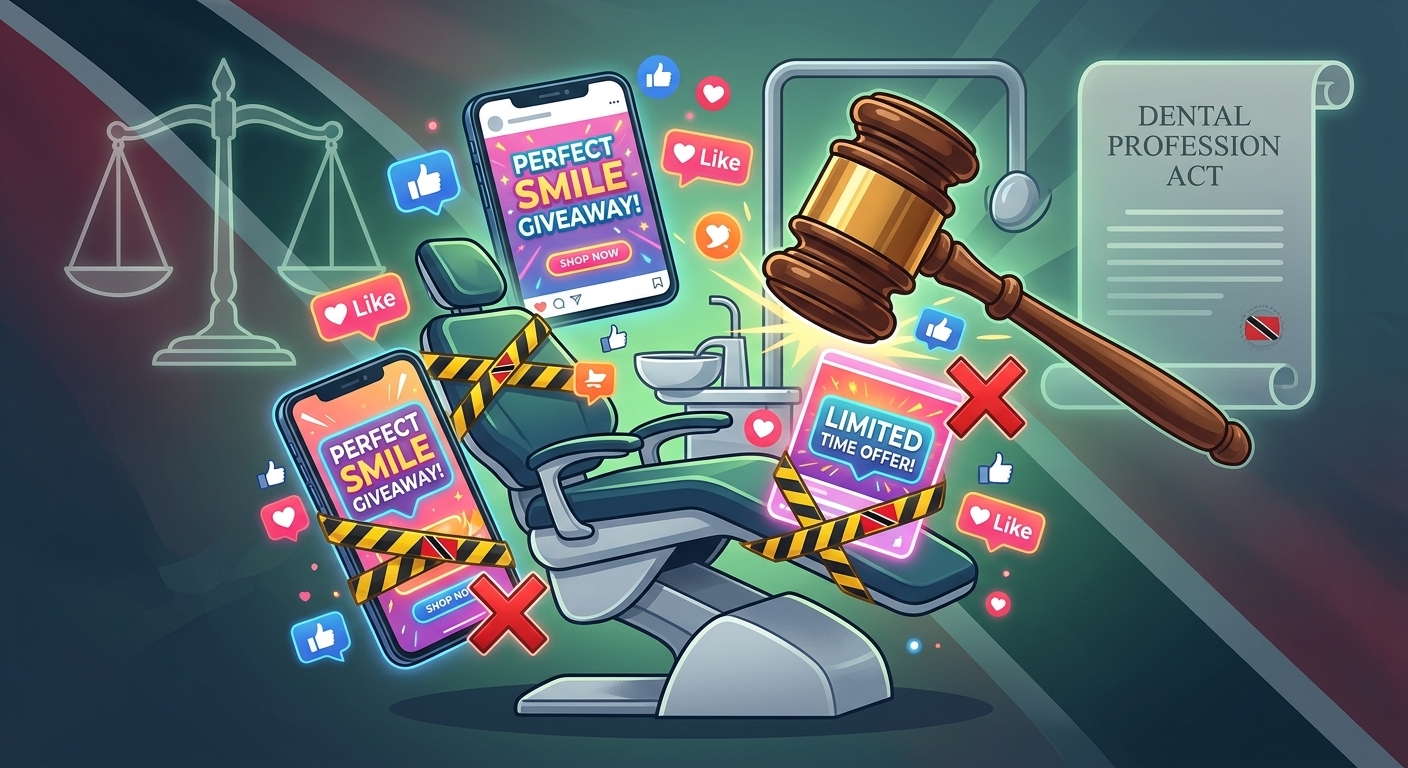
The Law vs. Dental Marketing in Trinidad & Tobago
Open Instagram or TikTok in Trinidad and Tobago, and you will inevitably see dental practices promoting teeth-whitening giveaways, influencer endorsements, patient transformation reels, and sponsored discount packages. To everyday consumers, this looks like standard business marketing. Under local law, however, it directly violates the professional code.
The Statutory Reality
Under the Dental Profession Act (Chap. 29:54) and guidelines enforced by the Dental Council of Trinidad and Tobago (DCTT), dental practitioners are held to strict non-commercial standards:
The Appellate Court’s Stance
This regulatory line is not merely theoretical. The Trinidad and Tobago Court of Appeal recently reaffirmed that the statutory prohibition against advertising by registered dentists is unambiguous under the law. The judiciary made it clear: professional regulatory bodies have a mandate to maintain professional integrity over aggressive commercial competition, and the current legislation leaves no loophole for modern digital marketing tactics.
Why Public Oversight Matters
When healthcare marketing mirrors retail consumerism, the line between medical necessity and commercial salesmanship blurs. Regulating medical and dental advertising exists to protect patients from predatory pricing schemes, exaggerated clinical claims, and unfair commercial advantages.
If statutory codes prohibit commercial promotion to preserve professional integrity, the law cannot simply be ignored online. Holding licensed professionals accountable to their governing statutes ensures transparency, preserves public trust, and reminds consumers that healthcare is a public service, not an algorithmic race for engagement.